

Best Portable Solar Panels for Camping (Black Friday 2026)
A research-based comparison of portable solar panels that pair with popular camping power stations, with connector and voltage compatibility, price-per-watt math, and cited independent test results.
Photo: Duc Nguyen / Pexels
Last updated: Oct 20, 2026
Disclosure: Ember & Amp is reader-supported. If you buy through links on this page, we may earn a commission at no extra cost to you. That never decides what we recommend. Read our full affiliate disclosure.
How we researched this: We have not tested these panels ourselves. This guide compares manufacturer-published specs and summarizes results from an independent reviewer that did test them (OutdoorGearLab). Every spec and price links to its source. All prices are as of Oct 20, 2026, taken from each brand's official US store. We don't list Amazon prices on this page. Prices change often around Black Friday, so check the live price before you buy.
This guide is written to pair with our portable power station guide. If you already own one of those stations, jump to Compatibility.
The short version
| Pick | Best for | Rated power | Weight | Connector out of the box | Price as of Oct 20, 2026 | Price per rated watt |
|---|---|---|---|---|---|---|
| Jackery SolarSaga 200W | Jackery Explorer 1000 v2 / 2000 v2 owners | 200W | 14.33 lb | Jackery DC8020 cable (+ DC7909 adapter) | $379, regularly $429 (Jackery) | $1.90/W |
| EcoFlow NextGen 220W Bifacial | Matching the RIVER 3 Plus; highest tested output | 220W front / 175W rear | ~15.4 lb | Solar connectors + XT60 cable | $399 (EcoFlow) | $1.81/W |
| Anker SOLIX PS200 Bifacial | Anker SOLIX C1000 Gen 2 owners; lightest 200W here | 200W | 10.6 lb | Solar cables + XT-60i cable | $499.99 (Anker SOLIX) | $2.50/W |
| Jackery SolarSaga 100 Air | Light, small budget top-ups for Jackery 1000 v2 / 2000 v2 | 100W | 7.1 lb | Jackery cable (+ DC8020-to-DC7909 adapter) | $249, regularly $299 (Jackery) | $2.49/W |
Price-per-watt math (price ÷ rated front-side watts, as of Oct 20, 2026): EcoFlow $399 ÷ 220W = $1.81/W; Jackery 200W $379 ÷ 200W = $1.90/W; Jackery 100 Air $249 ÷ 100W = $2.49/W; Anker $499.99 ÷ 200W = $2.50/W.
How to choose
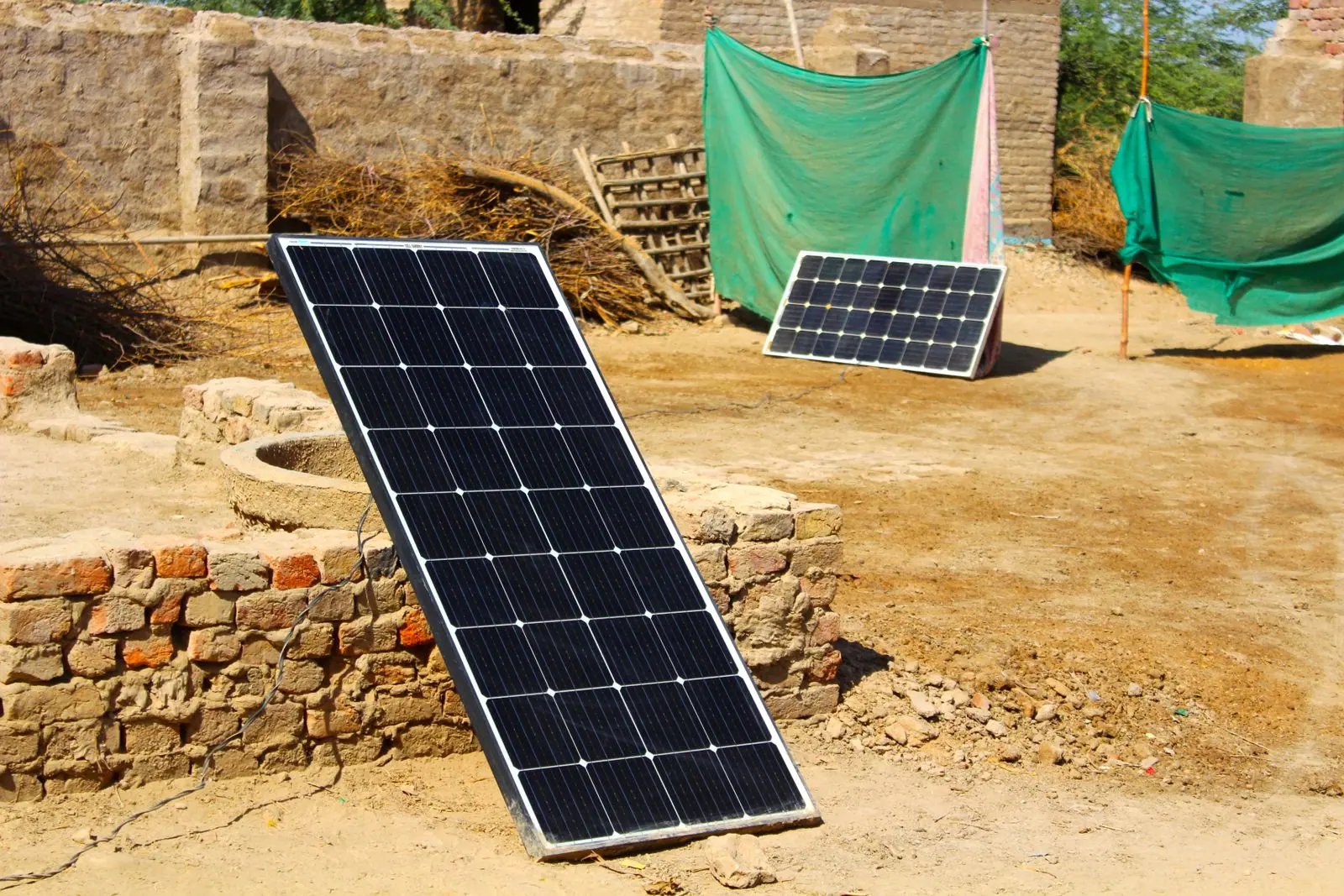
- Rated watts are lab numbers. Panels are rated under standard lab conditions. Real output is lower and depends on sun angle, heat, haze, and shading; Jackery's and Anker's own FAQs say the same (Jackery, Anker). In OutdoorGearLab's test, every 200W-class panel we cover produced roughly 83–88% of its rating (source).
- Match the panel to your station's input limits, not just its watt limit. Each station accepts a voltage range and a maximum current. A panel whose working voltage is low can be capped well below its rated watts (see the math below).
- Don't buy more watts than your station can take. The RIVER 3 Plus takes up to 220W of solar, so a second panel adds nothing. The Jackerys take up to 400W, and the Anker C1000 Gen 2 up to 600W.
- Cheaper is often enough. For a weekend of phones, lights, and a laptop, one panel that partly refills a small station each day is plenty. You only need 400W+ of panels if you're running a fridge for days off-grid.
- Check bundles. Jackery sells the Explorer 1000 v2 (black) with a SolarSaga 200W for $699, versus $499 + $379 = $878 bought separately, which saves $179 as of Oct 20, 2026 (source). If you're buying both, the bundle is usually the better deal.
The picks
1. Best for Jackery owners: Jackery SolarSaga 200W
- Rated power: 200W ±5% (225W ±5% under Jackery's bifacial test condition)
- Electrical: Voc 22V ±5%, Vmp 18V ±5%, Imp 11.5A ±5%
- Weight: 14.33 lb ±0.66 lb
- Ruggedness: IP68; operating range −4 to 149°F (Jackery lists the range two slightly different ways on the same page)
- Extras: USB-A (5V⎓2.4A) and USB-C (5V⎓3A) ports on the panel
- Warranty: 3+2 years (Jackery's listing)
- Price: $379 at Jackery, listed regular price $429 (price as of Oct 20, 2026)
- Source: Jackery product page
- What testers said: OutdoorGearLab measured 171W and described it as one of the most consistent folding panels they tested. Their downsides: it's expensive and needs adapters for non-Jackery stations (source).
Who it's for: anyone with a Jackery Explorer 1000 v2 or 2000 v2. It plugs in without third-party adapters, and two of them reach those stations' 400W solar limit.
2. Best match for the RIVER 3 Plus: EcoFlow NextGen 220W Bifacial
- Rated power: 220W (±5W) front, 175W rear
- Electrical: Voc 21.5V (Vmp 18.4V); Isc 12.4A (Imp 11.9A) front
- Efficiency: 25% (manufacturer claim)
- Weight: about 15.4 lb
- Ruggedness: IP68
- In the box: solar-to-XT60 charging cable, protective bag
- Warranty (US): 12 months, shorter than the Jackery 200W's and the Anker's
- Price: $399 at EcoFlow (price as of Oct 20, 2026)
- Source: EcoFlow product page
- What testers said: OutdoorGearLab measured 193W, the highest raw output of any folding panel they tested. They noted it often sells well below list price and that its connectors have no cover (source).
Who it's for: RIVER 3 Plus owners. Its 220W rating matches that station's 220W solar limit. Cheaper may be enough: if you only top off phones and lights, you don't need to max out the RIVER's input.
3. Best for Anker owners: Anker SOLIX PS200 Bifacial
- Rated power: 200W
- Electrical: PV output 48V⎓4.16A. Anker sells this panel as compatible with the C1000 Gen 2 (Anker C1000 Gen 2 page).
- Weight: 10.6 lb (Anker also says "just 11 lb including the stand")
- Ruggedness: IP68; 5-year warranty
- In the box: 2× 8.2 ft solar charging cables, 1.6 ft XT-60i solar charging cable
- Price: $499.99 at Anker SOLIX (price as of Oct 20, 2026)
- Source: Anker SOLIX product page
- What testers said: OutdoorGearLab measured 166W and liked its preset angle points and easy setup, but felt it's pricey for average output (source).
Who it's for: C1000 Gen 2 owners. Here's the plain trade-off: it costs about $100 more than the EcoFlow 220W ($499.99 − $399 = $100.99). On the C1000 Gen 2 that buys roughly 15W more real-world output, because OutdoorGearLab measured the PS200 at 166W, while a low-voltage panel like the EcoFlow is capped at about 151W on this station (166W − 151W ≈ 15W; see the math below). It's also about 5 lb lighter (15.4 lb − 10.6 lb = 4.8 lb). If you want the lightest, best-matched panel for the Anker, it's the pick. If you'd rather save $100, the EcoFlow still works on the C1000 Gen 2, just with a little less output.
4. Lightweight budget pick: Jackery SolarSaga 100 Air
- Rated power: 100W
- Weight: 7.1 lb
- Ruggedness: IP68; operating range −4 to 149°F
- Extras: USB ports on the panel
- In the box: 9.84 ft cable, DC8020-to-DC7909 adapter
- Compatibility note from Jackery: not compatible with the Explorer 300 v2, 300, 300D, or 240D for recharging
- Price: $249 at Jackery, listed regular price $299 (price as of Oct 20, 2026)
- Source: Jackery product page
Who it's for: Jackery owners who want something light for small daily top-ups. Honest take: at $2.49/W it costs more per watt than the SolarSaga 200W ($1.90/W). If weight doesn't matter, the 200W is the better value.
Compatibility: which panel works with which station
All station figures are from each brand's official spec page.
| Station | Solar port | Input limits (official) | Best-matched panel above |
|---|---|---|---|
| EcoFlow RIVER 3 Plus | — | 220W solar max (EcoFlow) | EcoFlow NextGen 220W |
| Anker SOLIX C1000 Gen 2 | XT60i | 11–28V⎓8.2A; 29–60V⎓14.5A; 600W max (Anker) | Anker SOLIX PS200 |
| Jackery Explorer 1000 v2 | 2× DC8020 (8mm) | 12–16V⎓8A; 16–60V⎓10.5A per port, 400W max combined (Jackery) | Jackery SolarSaga 200W |
| Jackery Explorer 2000 v2 | 2× DC 8mm (Jackery) | 11–16V⎓8A; 16–60V⎓12A, 400W max combined (Jackery) | Jackery SolarSaga 200W |
Why voltage matters (the math). Input power is capped at voltage × allowed current.
- EcoFlow 220W on an Anker C1000 Gen 2: the panel's 18.4V working voltage is in the C1000's 11–28V band, capped at 8.2A. 18.4V × 8.2A ≈ 151W, so you'd get about 151W at most, not 220W. Compare the Anker PS200: 48V × 4.16A ≈ 200W, which is inside the 29–60V band (14.5A max), so it isn't capped.
- Jackery SolarSaga 200W on a Jackery 1000 v2: 18V × 10.5A = 189W per port at most. Two panels on two ports stay under the 400W combined limit.
- Jackery SolarSaga 200W on an Anker C1000 Gen 2: 18V is in the 11–28V band, so 18V × 8.2A ≈ 148W at most.
- Mixing brands in general: EcoFlow and Anker panels ship with XT60/XT-60i cables, and Jackery's stations use DC8020. Using a non-Jackery panel on a Jackery means a third-party adapter. Stick with same-brand pairings unless you're comfortable checking voltage specs yourself.
- Only connect panels the way your station's manual describes, and never exceed its maximum input voltage.
What about cheaper third-party panels?
OutdoorGearLab's overall top pick was a Renogy 200W folding panel, which tested at 177W and was the best value in their lineup (source). We haven't included it as a pick here. Cheap third-party panels can be good enough, but you'll usually need an adapter, so check the voltage specs against the table above.
Black Friday tips
- Black Friday is Nov 27, 2026, and brand sales usually start earlier. We'll refresh these prices around Nov 17–20 and again on Black Friday.
- Compare panel + station bundles against buying separately. As of Oct 20, 2026, Jackery's 1000 v2 + SolarSaga 200W bundle saves $179 (see above).
- Compare price per watt: divide the price by rated watts. If a sale changes a price, redo the math.
Bottom line
Buy the panel made by your station's brand. Jackery SolarSaga 200W for the Explorer 1000 v2 or 2000 v2 (or the bundle, if you're buying both). EcoFlow NextGen 220W for the RIVER 3 Plus. Anker SOLIX PS200 for the C1000 Gen 2: it costs about $100 more than the EcoFlow 220W for roughly 15W more real-world output on that station (166W measured vs. a ~151W cap on a low-voltage panel), and it's about 5 lb lighter. The EcoFlow is a reasonable lower-cost choice there too. If you only charge small devices, one panel is enough, and you don't need to max out your station's solar input.
Specs are manufacturer-published and not independently tested by Ember & Amp. Prices as of Oct 20, 2026. Solar output varies with conditions.